
10 balance exercises for beginners at home can help you feel steadier on your feet in just a few minutes a day. Balance is a skill you use every time you reach for a shelf, step off a kerb, or carry washing across the room, and it responds quickly to gentle, regular practice. These exercises need no equipment, no gym, and no previous experience.
This guide keeps safety first. Every exercise starts with a sturdy chair or counter within reach, and you stay supported until you feel ready to let go for a few seconds. You will find ten moves that work your feet, ankles, legs, and core, plus a simple way to fit them into your week.
The 10 balance exercises for beginners at home below are written for real living rooms and kitchens, not a studio. Pick one to try today, and add the rest one at a time as your confidence grows.
Table of Contents
Why Balance Matters More Than You Think
Balance is easy to take for granted until a wobble reminds you it is there. Your body keeps you upright by combining signals from your eyes, your inner ear, and the small muscles in your feet and ankles, and each of those systems benefits from regular use. Gentle balance practice keeps those signals sharp, so everyday movements feel smoother and more confident.

Falls are a real concern as we age, and the CDC notes that more than one in four older adults falls each year. The 10 balance exercises for beginners at home in this guide are a gentle way to work on steadiness, and the CDC STEADI fall prevention pages explain how screening, simple strength work, and balance practice fit together. This guide gives general information only, and it is not a substitute for medical advice.
Balance also supports the rest of your routine. When your footing feels secure, walking feels easier, stairs feel less daunting, and you are more likely to stay active. Pairing balance work with indoor walking workouts at home can keep your legs strong and your steps confident through the winter months.
The good news is that balance improves with small, regular doses, and the 10 balance exercises for beginners at home are built for exactly that kind of practice. Five to ten minutes a day is enough to start, and most people notice steadier footing within a few weeks. You do not need to be flexible, fit, or young to begin, and you do not need to master every move at once.
How to Practise Balance Safely at Home
Set yourself up well before you start. Clear a small space on a flat floor, keep a sturdy chair or kitchen counter within arm’s reach, and wear flat shoes or bare feet on a non-slip surface. The 10 balance exercises for beginners at home below all begin supported, so you can hold on as much as you need.
Start supported and progress slowly. Hold the chair with both hands at first, then one hand, then just a fingertip, and only let go completely when you feel steady. If you enjoy gentle seated movement too, these gentle chair yoga poses pair well with standing balance work.
Listen to your body and stop if you feel dizzy, light-headed, or unwell. Sit down, drink some water, and rest until the feeling passes. If dizziness keeps happening, or you have a history of falls or a condition that affects your balance, talk with your doctor before starting a new routine.
Practise the 10 balance exercises for beginners at home little and often rather than in one long session. Two or three short sessions a day beat a single tiring one, and your muscles and nerves learn faster when they are fresh. Keep your gaze on a fixed point ahead of you, breathe normally, and keep your knees soft rather than locked.
10 Balance Exercises for Beginners at Home
Use this list as a gentle menu, not a test. Each exercise below tells you what it is, who it suits, how to do it, a pro tip, and a mistake to avoid. The 10 balance exercises for beginners at home cover standing, walking, sitting, and floor work, so you can mix them to suit your day.

Start with the first two or three moves and add one new exercise each week. If you want a fuller home routine, these zone 2 cardio workouts offer steady, low-intensity sessions that sit well alongside balance practice. For now, begin with the move that sounds easiest, and build from there.
1. Supported Single-Leg Stand
What it is: Standing on one leg while lightly holding a sturdy chair, the simplest balance drill there is and the foundation for everything else in this guide.
Who it suits: This move suits complete beginners and anyone who feels wobbly on their feet, and it is one of the 10 balance exercises for beginners at home that you can practise while the kettle boils.
How to do it: Stand behind a sturdy chair with both hands on the backrest. Lift one foot a few inches off the floor and hold for 10 seconds, then lower it and switch sides. Repeat three times on each leg, breathing normally throughout.
Pro tip: Fix your eyes on a spot on the wall at eye level, since a steady gaze helps your body stay upright.
Mistake to avoid: Do not lock your standing knee, since a stiff leg makes you wobble more, not less.
2. Heel-to-Toe Walk
What it is: Walking slowly in a straight line with the heel of each step touching the toes of the foot in front, like walking along a narrow beam on the floor.
Who it suits: This move suits anyone who wants steadier walking and more confident steps, and it is one of the 10 balance exercises for beginners at home that turns a hallway into a practice space.
How to do it: Stand near a wall or counter so you can touch it if needed. Place one foot directly in front of the other, heel to toe, and take 10 slow steps forward. Turn carefully, using the wall for support, and walk back the same way.
Pro tip: Take small, slow steps and keep your arms out to the sides, since speed is not the goal here.
Mistake to avoid: Do not look down at your feet, since dropping your gaze throws your balance off.
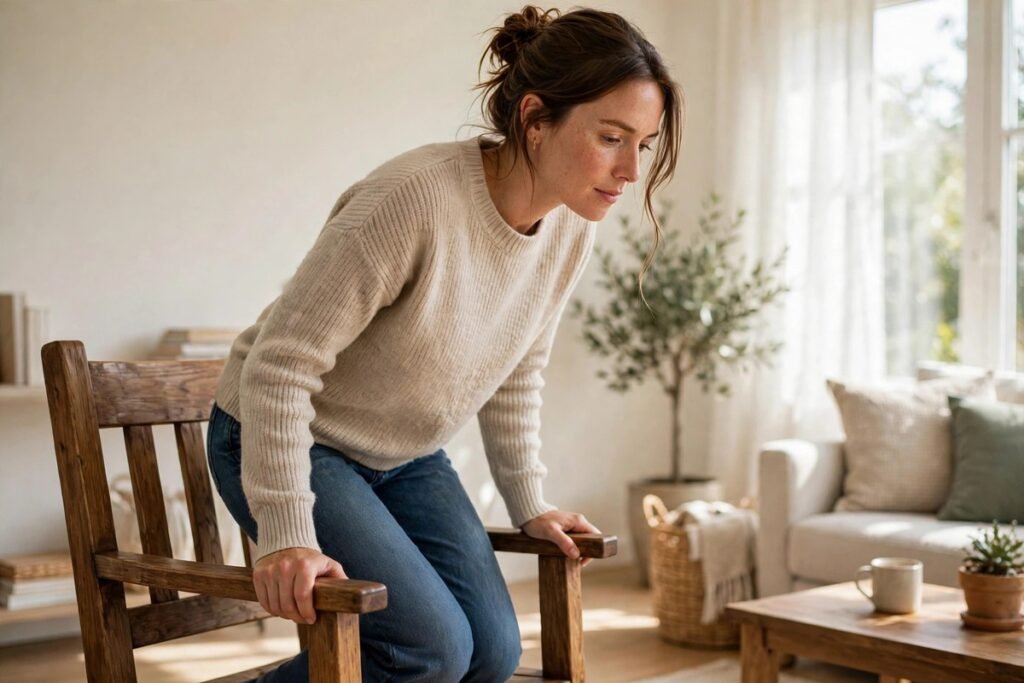
3. Sit-to-Stand
What it is: Rising slowly from a chair to standing without using your hands, a everyday movement that builds leg strength and balance at the same time.
Who it suits: This move suits anyone who finds getting up from a chair harder than it used to be, and it is one of the 10 balance exercises for beginners at home that doubles as a strength exercise.
How to do it: Sit near the front of a sturdy chair with your feet flat on the floor. Lean forward slightly, press through your heels, and stand up slowly. Pause, then lower yourself back down with control. Repeat 8 to 10 times.
Pro tip: Cross your arms over your chest once the move feels easy, since that removes the extra help from your hands.
Mistake to avoid: Do not push off the chair with your hands at the start, since your legs need to do the work for this to help.
4. Clock Taps
What it is: Standing on one leg and tapping the other foot lightly at imaginary clock positions around you, a playful drill that trains balance in every direction.
Who it suits: This move suits anyone who can stand on one leg for a few seconds and wants a gentle challenge, and it is one of the 10 balance exercises for beginners at home that keeps practice interesting.
How to do it: Stand beside a chair and hold it lightly with one hand. Lift one foot and tap it forward at 12 o’clock, then to the side at 3 o’clock, then behind you at 6 o’clock. Return to the middle each time, then switch legs.
Pro tip: Keep the taps light and quick, like touching a hot surface, so your weight stays on the standing leg.
Mistake to avoid: Do not reach too far with the tapping foot, since a big reach pulls you off balance.
5. Bird Dog
What it is: A hands-and-knees exercise where you extend one arm forward and the opposite leg back, training your core and your balance together on the floor.
Who it suits: This move suits anyone who is comfortable kneeling on a mat and wants core stability, and it is one of the 10 balance exercises for beginners at home that works well before bed.
How to do it: Start on hands and knees on a mat, with your hands under your shoulders and your knees under your hips. Slowly extend your right arm forward and your left leg back until both are level. Hold for 5 seconds, then return and switch sides. Repeat five times per side.
Pro tip: Keep your hips level and your back flat, as if a glass of water were balanced on your lower back.
Mistake to avoid: Do not arch your lower back as you extend, since that takes the work away from your core.
6. Tandem Stand
What it is: Standing still with one foot directly in front of the other, heel to toe, holding the position while your body learns to stay steady on a narrow base.
Who it suits: This move suits anyone who has tried the single-leg stand and wants the next step up, and it is one of the 10 balance exercises for beginners at home that needs no space at all.
How to do it: Stand beside a counter and hold it with one hand. Place one foot directly in front of the other, heel touching toe, and hold for 20 to 30 seconds. Switch feet and repeat, aiming for three holds on each side.
Pro tip: Start with your feet a few inches apart and move them closer over the week, so the challenge grows gradually.
Mistake to avoid: Do not hold your breath while you balance, since steady breathing keeps you relaxed and steady.
7. Heel Raises
What it is: Rising slowly onto the balls of your feet and lowering back down, a simple calf-strengthening move that improves the push-off power in every step.
Who it suits: This move suits anyone who wants stronger ankles and calves, and it is one of the 10 balance exercises for beginners at home that you can do at the kitchen counter.
How to do it: Stand behind a counter with your fingertips resting on it. Rise onto the balls of your feet over two seconds, hold for a moment, then lower slowly over two seconds. Repeat 10 to 12 times, keeping your body tall throughout.
Pro tip: Rise straight up rather than leaning forward, since leaning shifts your weight and spoils the balance work.
Mistake to avoid: Do not rush the lowering phase, since the slow return is where most of the benefit lies.
8. Supported Step-Ups
What it is: Stepping up onto a low, sturdy step and back down again, a practical move that mirrors stairs and kerbs and builds confidence for both.
Who it suits: This move suits anyone who wants to feel steadier on stairs, and it is one of the 10 balance exercises for beginners at home that prepares you for real life outside the house.
How to do it: Stand facing a low step or the bottom stair, with a handrail or counter nearby. Step up with one foot, bring the other foot up beside it, then step back down one foot at a time. Repeat 6 to 8 times, then lead with the other foot.
Pro tip: Place your whole foot on the step, not just your toes, so your base is solid before you lift your weight.
Mistake to avoid: Do not use a step that is too high or unsteady, since a wobbly step turns a safe exercise into a risk.
9. Sideways Walking
What it is: Walking sideways in small, controlled steps along a counter, a move that strengthens the hip muscles that keep you stable when you change direction.
Who it suits: This move suits anyone who feels unsteady when turning or stepping sideways, and it is one of the 10 balance exercises for beginners at home that fills a gap most routines miss.
How to do it: Stand sideways beside a kitchen counter and rest one hand on it. Step sideways with the foot nearest the counter, then bring the other foot to meet it, keeping your toes pointing forward. Take 10 steps in one direction, then turn and walk back.
Pro tip: Keep your steps small and your knees soft, and focus on smooth, even movement rather than speed.
Mistake to avoid: Do not cross one foot over the other, since crossed feet are the easiest way to trip.
10. Marching with Pauses
What it is: Marching gently in place and pausing on one leg for a few seconds after every few steps, a moving balance drill that builds confidence for real walking.
Who it suits: This move suits anyone who can walk around the house and wants to practise balance in motion, and it is one of the 10 balance exercises for beginners at home that feels most like everyday life.
How to do it: Stand near a chair and march in place, lifting your knees to a comfortable height. Every fourth step, pause and hold on one leg for 3 seconds before continuing. March for one minute, rest, and repeat once more.
Pro tip: Swing your arms naturally as you march, since the arm swing helps your body find its rhythm.
Mistake to avoid: Do not march too fast, since the pause is the balance part and it needs time to work.
How to Build a Simple Weekly Balance Routine
A little structure turns the 10 balance exercises for beginners at home into a habit that sticks. Pick three or four exercises for the week, and practise them for five to ten minutes on most days. This keeps the routine short enough to fit into a morning or an evening without feeling like a chore.
Aim for short sessions spread across the week rather than one long workout. The physical activity guidelines for adults suggest regular activity each week, including muscle-strengthening and balance work for older adults, and these small sessions count toward that goal. If you are new to exercise, start small and talk with your doctor first if you have a health condition.
Add strength once balance feels steadier. Strong legs support better balance, so a little strength work is a natural next step when you are ready. These dumbbell workouts for women show how to add light weights safely at home, with clear guidance for each move.
Track your progress through the 10 balance exercises for beginners at home in a simple way. Note how long you can stand on one leg, or how far you can walk heel to toe without touching the wall, and check again in two weeks. Small gains are real gains, and seeing them written down keeps motivation high.
Frequently Asked Questions About 10 Balance Exercises for Beginners at Home
The 10 balance exercises for beginners at home above cover a lot of ground, so here are answers to the questions readers ask most often. If you are new to balance work, start with the single-leg stand and the sit-to-stand, since both are forgiving and easy to practise with support.

Can 10 balance exercises for beginners at home help if I feel unsteady?
Yes, they can help, and feeling unsteady is exactly the reason to start. The 10 balance exercises for beginners at home begin with support nearby, so you can hold on as much as you need while your steadiness improves. Start with the supported single-leg stand and the sit-to-stand, and add new moves only when the first ones feel comfortable.
How often should I practise balance exercises?
A few minutes most days works best. Five to ten minutes, four or five days a week, is enough to build steadier footing over a few weeks. Short, regular sessions help your body learn faster than one long session, so fit them into moments you already have, such as while the kettle boils.
Do I need any equipment for these exercises?
No, you need no special equipment. A sturdy chair or kitchen counter is your main support, and a mat makes the floor exercises more comfortable. Wear flat shoes or go barefoot on a non-slip floor, and clear a small space before you begin.
What should I do if I feel dizzy during an exercise?
Stop straight away and sit down. Rest until the feeling passes, drink some water, and do not try to push through dizziness. If dizziness happens often, or you have a history of falls or a condition that affects your balance, talk with your doctor before practising again.
Can I do balance exercises every day?
Yes, gentle balance work can be part of your daily routine. These moves are low intensity, so most people can practise them daily without tiring their muscles. If a muscle feels sore after the sit-to-stand or step-ups, take a rest day for that move and keep the gentler standing exercises instead.
10 Balance Exercises for Beginners at Home to Try First
The 10 balance exercises for beginners at home in this guide prove that steadier footing does not need a gym or special equipment. From the single-leg stand and the heel-to-toe walk to the bird dog and the sit-to-stand, there is one here for every living room and every starting point.

Pick one exercise from the 10 balance exercises for beginners at home to try this week, and keep the rest for the weeks ahead. Small, steady habits are easier to keep than a big overhaul.
If one exercise does not suit you, set it aside and try another one of the 10 balance exercises for beginners at home. Then keep exploring the guides on Well Fit Look for more gentle, seasonal ideas for your home routine.


1 Comment